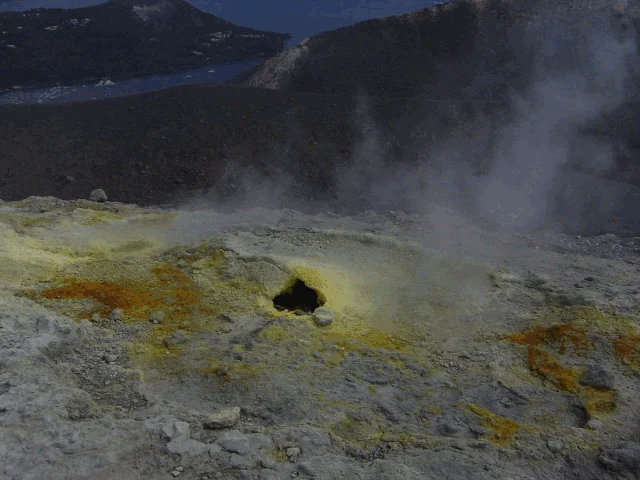
Vulcano is a stratovolcano located in Italy, positioned within a subduction zone on continental crust exceeding 25 km in thickness. Standing at an elevation of 500 meters with coordinates 38.404° N, 14.962° E, it is documented in the Smithsonian Global Volcanism Program records as having a total of 37 confirmed eruptions.
The historical and prehistoric record for Vulcano spans thousands of years, encompassing activity across different vents and areas such as the Lentia NW side, offshore vents, Vulcanello, and Fossa. The earliest recorded eruption in the collection dates back to 6550 BCE, determined through isotopic K/Ar evidence, while the structured record documents activity extending into the late 19th century, concluding with an eruption sequence spanning from August 2, 1888, to March 22, 1890.
Chronology and Eruption History
The confirmed eruption record covers 37 distinct events evaluated through various observation methods and dating techniques, including reported historical observations and isotopic analysis. Among these, the largest recorded Volcanic Explosivity Index (VEI) reaches 4.0, which was documented during the 183 BCE eruption at Vulcanello. Out of the 37 confirmed events, 23 have associated VEI observations.
Activity at the volcano is distributed across multiple centuries, showing varying frequencies from antiquity through the modern historical period. Representative entries from the official record illustrate the chronological span and diverse locations of activity:
- 6550 BCE (approximate start): Located on the NW side (Lentia), investigated via K/Ar isotopic evidence.
- 215 BCE: Located at an offshore vent, recorded through historical observation.
- 183 BCE: Located at Vulcanello, recorded with a VEI of 4.0.
- 0729 CE: Located at Fossa, recorded through historical observation.
- August 2, 1888 – March 22, 1890: Located at Fossa, recorded with a VEI of 3.0.
Century-by-Century Distribution
The confirmed eruptions are distributed across multiple centuries BCE and CE. The official dataset records activity in the following temporal buckets:
- 66th century BCE: 1 event
- 64th century BCE: 1 event
- 36th century BCE: 1 event
- 27th century BCE: 1 event
- 13th century BCE: 1 event
- 10th century BCE: 1 event
- 5th century BCE: 1 event
- 4th century BCE: 1 event
- 3rd century BCE: 2 events
- 2nd century BCE: 3 events
- 1st century BCE: 2 events
- 1st century CE: 1 event
- 2nd century CE: 1 event
- 6th century CE: 1 event
- 8th century CE: 1 event
- 10th century CE: 1 event
- 11th century CE: 1 event
- 12th century CE: 1 event
- 13th century CE: 1 event
- 15th century CE: 1 event
- 16th century CE: 1 event
- 17th century CE: 5 events
- 18th century CE: 4 events
- 19th century CE: 3 events
Frequently asked questions
Where is Vulcano located?
Vulcano is located in Italy.
How many eruptions are recorded for Vulcano?
The Smithsonian Global Volcanism Program records 37 confirmed eruptions for Vulcano.
When did the earliest recorded eruption occur?
The earliest recorded eruption in the dataset dates back to 6550 BCE.
What is the largest recorded VEI for Vulcano?
The largest recorded Volcanic Explosivity Index (VEI) for Vulcano is 4.0, which occurred during the 183 BCE eruption at Vulcanello.
Image credits
- Benjamín Núñez González — Wikimedia Commons source — CC BY-SA 4.0
Sources and further context
Official datasets support the event-specific facts.