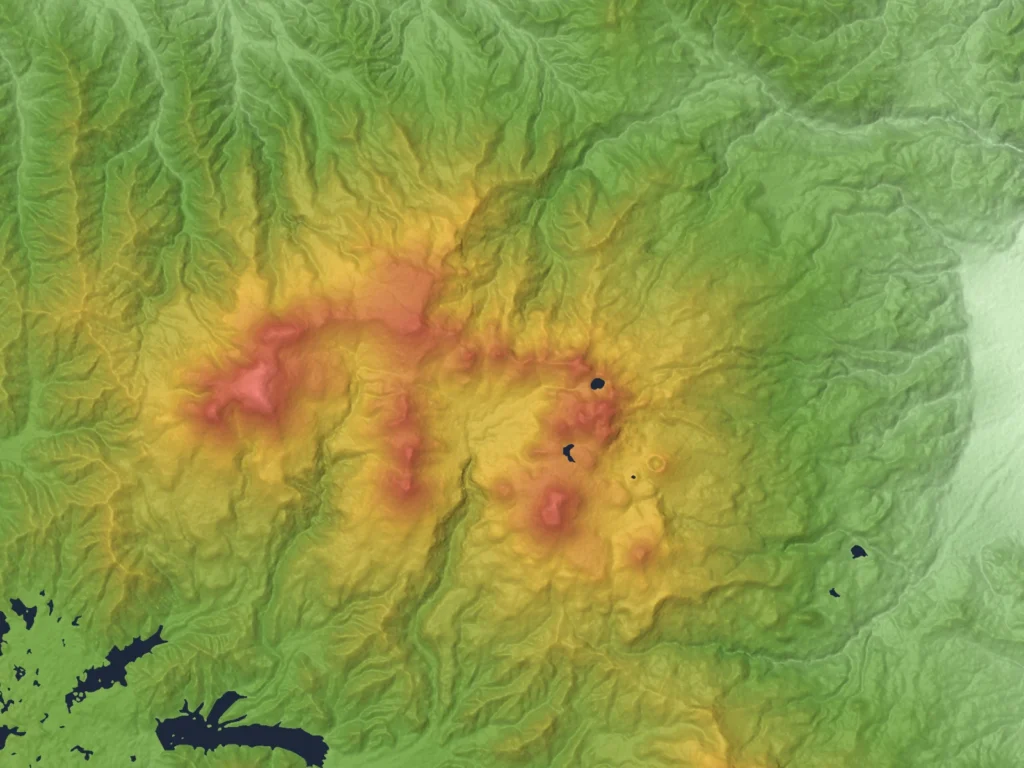
Azumayama is a stratovolcano located in Japan, standing at an elevation of 1,949 meters within a subduction zone and continental crust tectonic setting. According to the Smithsonian Global Volcanism Program, the volcano has a recorded history of 19 confirmed eruptions. These events span a vast timeline, stretching from prehistoric activity recorded through calibrated isotopic dating up to historical observations in the 20th century.
Overview of Recorded Eruptions
The earliest recorded eruption in Azumayama's timeline dates back to 5700 BCE (with a start year uncertainty of 50 years) at the Oke-numa activity area, registering a Volcanic Explosivity Index (VEI) of 2.0. Over subsequent millennia, various activity areas across the volcanic complex have produced confirmed eruptions using evidence methods ranging from calibrated radiocarbon dating for ancient events to direct human reporting for modern episodes.
Among the recorded events, the largest known Volcanic Explosivity Index associated with the volcano is 3.0. A notable example of this magnitude occurred at the Azuma Ko-Fuji activity area around 4150 BCE, carrying an uncertainty span of 500 years. Other prehistoric events include activity at Issaikyo around 3000 BCE with a VEI of 1.0, and an unassigned activity area event around 600 CE with an uncertainty of 200 years.
Twentieth-Century Activity
The latest recorded eruption in the official database took place at the Issaikyo (Oana) activity area on December 7, 1977. This event was documented through direct observations and reports, carrying a VEI of 1.0. The official record lists the latest confirmed eruption date as December 7, 1977, and indicates that the event was not continuing.
Image credits
- Batholith — Wikimedia Commons source — Public domain
Sources and further context
Official datasets support the event-specific facts.