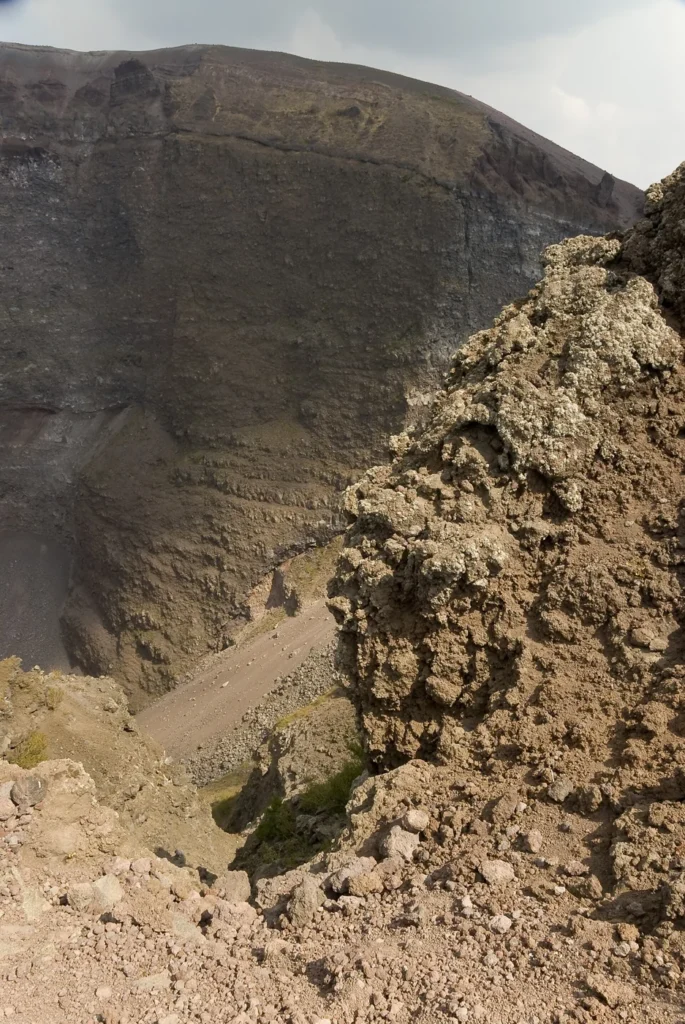
Geological Profile and Setting of Vesuvius
Vesuvius is a stratovolcano situated in Italy at latitude 40.821° N and longitude 14.426° E, reaching an elevation of 1,281 meters above sea level. The volcano is located in a subduction zone setting on continental crust with a thickness exceeding 25 kilometers. Documentation from the Smithsonian Global Volcanism Program records 54 confirmed eruptive periods for Vesuvius spanning several millennia.
Historical Eruption Frequency and Explosivity
Of the 54 confirmed eruptions in the volcano's record, 53 have an assigned Volcanic Explosivity Index (VEI) magnitude. The maximum recorded magnitude reaches VEI 5.0. Evidence for ancient activity relies on calibrated radiocarbon isotopic analysis, while activity from the 1st millennium CE onward is largely established through historical reports.
The confirmed eruptive events are distributed across time as follows:
- Prehistoric Eras (BCE): 70th century BCE (1 eruption), 25th century BCE (1 eruption), 16th century BCE (1 eruption), 15th century BCE (1 eruption), 9th century BCE (1 eruption), 6th century BCE (1 eruption), and 3rd century BCE (1 eruption).
- 1st to 12th Centuries CE: 1st century CE (1 eruption), 2nd century CE (1 eruption), 3rd century CE (2 eruptions), 4th century CE (1 eruption), 5th century CE (1 eruption), 6th century CE (2 eruptions), 7th century CE (1 eruption), 8th century CE (1 eruption), 9th century CE (2 eruptions), 10th century CE (3 eruptions), 11th century CE (2 eruptions), and 12th century CE (2 eruptions).
- 15th to 20th Centuries CE: 15th century CE (1 eruption), 16th century CE (1 eruption), 17th century CE (7 eruptions), 18th century CE (10 eruptions), 19th century CE (8 eruptions), and 20th century CE (1 eruption).
Documented Eruptive Periods and Observations
The earliest documented eruption in the official record began around 6940 BCE (with an uncertainty of ±100 years). This event produced a magnitude of VEI 5.0, identified via calibrated carbon-14 isotopic dating.
Historical observational reporting details several major later events, including a VEI 4.0 eruption starting on July 8, 512 CE, and a VEI 2.0 eruption in 1500 CE. Another major VEI 5.0 event began on December 16, 1631 CE, and ended on January 31, 1632 CE, involving activity across the summit as well as the southwest and south flanks.
The most recent structured eruptive period began on July 5, 1913 CE, and concluded on April 4, 1944 CE. Classified at VEI 3.0, activity during this period was concentrated at the summit and upper flanks, establishing 1944 CE as the volcano's last known eruption year.
Frequently asked questions
How many confirmed eruptions are recorded for Vesuvius?
The Smithsonian Global Volcanism Program records 54 confirmed eruptions for Vesuvius, beginning in prehistoric times and continuing into the 20th century.
What is the highest Volcanic Explosivity Index (VEI) recorded at Vesuvius?
The highest recorded Volcanic Explosivity Index for Vesuvius is VEI 5.0, which occurred during a prehistoric eruption around 6940 BCE (±100 years) and during a major historical eruption from December 16, 1631 CE, to January 31, 1632 CE.
When did the most recent recorded eruptive episode of Vesuvius take place?
The structured eruption record documents an eruptive period beginning on July 5, 1913 CE, and ending on April 4, 1944 CE, marking 1944 CE as the profile's last known eruption year.
Image credits
- S J Pinkney https://www.flickr.com/people/spinkney/ — Wikimedia Commons source — CC BY 2.0
Sources and further context
Official datasets support the event-specific facts.