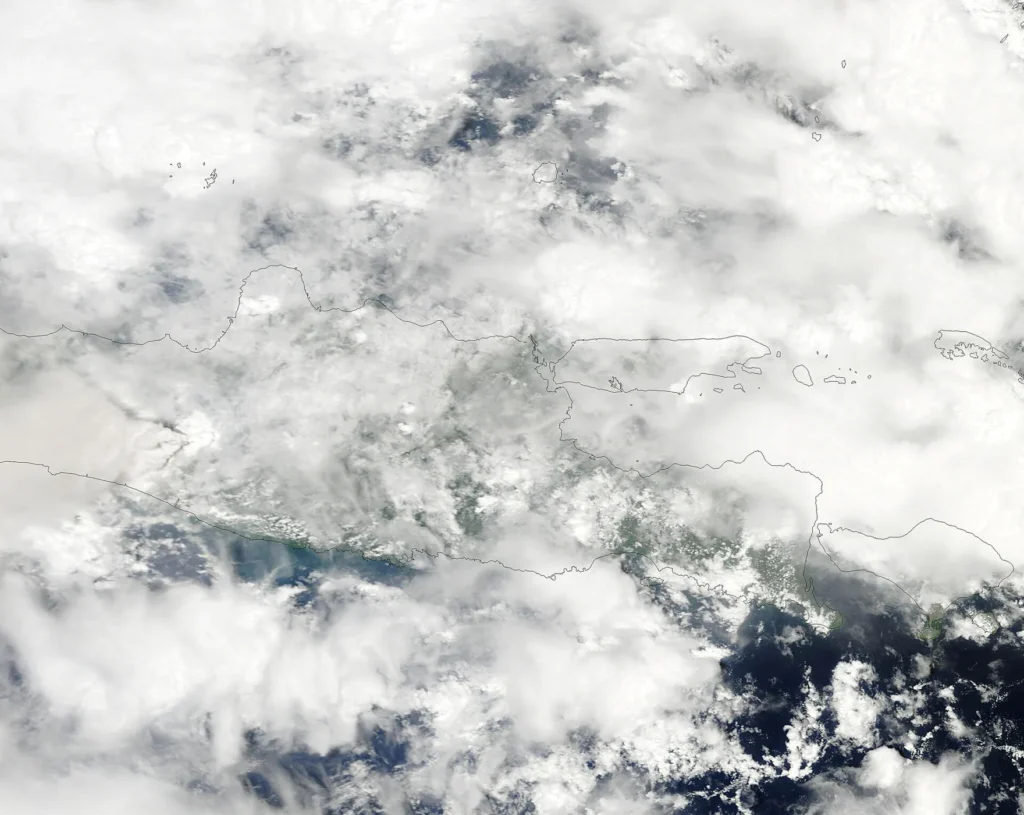
Volcanic Overview and Setting
Merapi (volcano number 263250) is a stratovolcano located in Indonesia at latitude -7.54° and longitude 110.446°. The volcano reaches an elevation of 2,910 meters above sea level and sits within a tectonic setting defined as a subduction zone on continental crust exceeding 25 kilometers in thickness.
According to data compiled by the Smithsonian Global Volcanism Program, Merapi has 106 confirmed eruptions in its historical and geological record. The earliest recorded event dates back to approximately 8780 BCE, while documented activity extends through recent years.
Historical Eruption Chronology and Evidence Methods
The historical dataset for Merapi spans more than ten thousand years, utilizing different scientific evidence methods depending on the era of activity. Prehistoric events were established through calibrated radiocarbon (14C) isotopic dating, whereas events in recent centuries are documented through reported human observations.
The frequency of documented eruptions varies substantially across centuries, reflecting both geological activity and the preservation of evidence:
- Pre-Common Era (BCE): Isolated eruptions are recorded in the 88th, 74th, 47th, 30th, 19th, 18th, 15th, 12th, 11th, 7th, and 4th centuries BCE, each represented by a single confirmed event identified via radiocarbon analysis.
- Early Common Era (1st–15th Century CE): Records show between 1 and 2 confirmed eruptions per century. For example, 2 eruptions are recorded in each of the 2nd, 5th, 7th, 11th, 12th, 13th, and 15th centuries CE.
- Modern Historical Era (16th–21st Century CE): Documented eruption counts rise significantly with increased reporting. The record includes 5 eruptions in the 16th century CE, 5 in the 17th century CE, 7 in the 18th century CE, 27 in the 19th century CE, 23 in the 20th century CE, and 8 in the 21st century CE.
Volcanic Explosivity Index (VEI) and Representative Eruptions
The Volcanic Explosivity Index (VEI) measures the explosive magnitude of an eruption on an open-ended logarithmic scale from 0 upward. Among the 106 confirmed eruptions at Merapi, VEI observations are available for 80 events. The maximum VEI recorded for Merapi in the official record is 4.0.
The table below presents representative examples from the stored eruption records, illustrating different eras, evidence methods, and recorded VEI values. These five entries serve as illustrative examples of the full 106-eruption database.
| Start Date | End Date | Activity Area | Evidence Method | VEI |
|---|---|---|---|---|
| 8780 BCE (±150 years) | Unrecorded | Old Merapi | Isotopic: 14C (calibrated) | Unrecorded |
| 1230 CE (±200 years) | Unrecorded | Unspecified | Isotopic: 14C (calibrated) | Unrecorded |
| December 18, 1828 | December 19, 1828 | Unspecified | Observations: Reported | 2.0 |
| October 26, 2010 | November 29, 2010 | Summit crater | Observations: Reported | 4.0 |
| December 31, 2020 | March 25, 2026 | Unspecified | Observations: Reported | 1.0 |
Interpreting the Eruption Record
The increase in documented eruptions starting in the 19th century reflects the transition from physical radiocarbon sampling to systematic human record-keeping. Sparsity in the early record does not imply an absence of activity during those centuries, but rather highlights the limitations of preserving physical material suitable for radiocarbon dating.
Historical eruption logs provide a long-term record of activity and physical observations. They describe past events and geological data, and are distinct from real-time monitoring or short-term hazard forecasting.
Frequently asked questions
How many confirmed eruptions are recorded for Merapi?
There are 106 confirmed eruptions recorded for Merapi in the official database compiled by the Smithsonian Global Volcanism Program.
What is the highest recorded Volcanic Explosivity Index (VEI) for Merapi?
The highest recorded Volcanic Explosivity Index (VEI) for Merapi is 4.0, observed among the 80 eruptions that have assigned VEI ratings.
When did the earliest recorded eruption of Merapi occur?
The earliest recorded eruption of Merapi occurred around 8780 BCE (with an uncertainty of ±150 years), identified at Old Merapi using calibrated radiocarbon (14C) dating.
Image credits
- MODIS Rapid Response — Wikimedia Commons source — Public domain
Sources and further context
Official datasets support the event-specific facts.