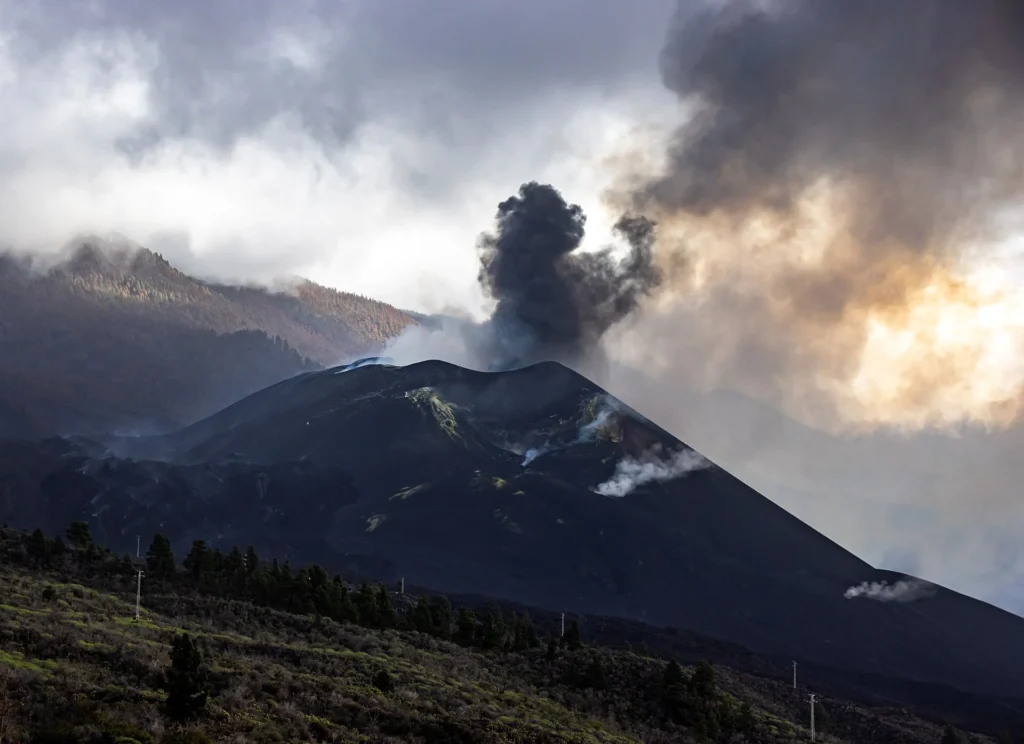
La Palma is an intraplate stratovolcano located in Spain, featuring an elevation of 2,426 meters and situated on oceanic crust less than 15 kilometers thick. According to the Smithsonian Global Volcanism Program, the volcano has a confirmed record of 14 eruptions stretching from deep antiquity through the modern era.
The historical and geological record of La Palma distinguishes between ancient events determined through isotopic evidence and more recent activity captured by direct human observation. The earliest recorded eruption in the official dataset dates back to 6050 BCE, with a start year uncertainty of 1,500 years, established via potassium-argon (K/Ar) isotopic dating. Subsequent prehistoric activity includes events identified through carbon-14 dating, such as an eruption around 1320 BCE.
Written and reported observations become part of the record starting in the 15th century CE. For example, an eruption at the Tacande activity area (Montaña Quemada) began in 1481 CE with a VEI of 2.0. Later historical accounts document eruptions at locations such as El Charco, which spanned from October 9, 1712, to December 3, 1712, also registering a VEI of 2.0.
The most recent confirmed activity in the official record is the Tajogaite eruption, which began on September 19, 2021, and ended on December 13, 2021, reaching a Volcanic Explosivity Index (VEI) of 3.0. Across all recorded events where a VEI has been assigned, the largest recorded magnitude in the dataset is VEI 3.0.
Sources and further context
Official datasets support the event-specific facts.