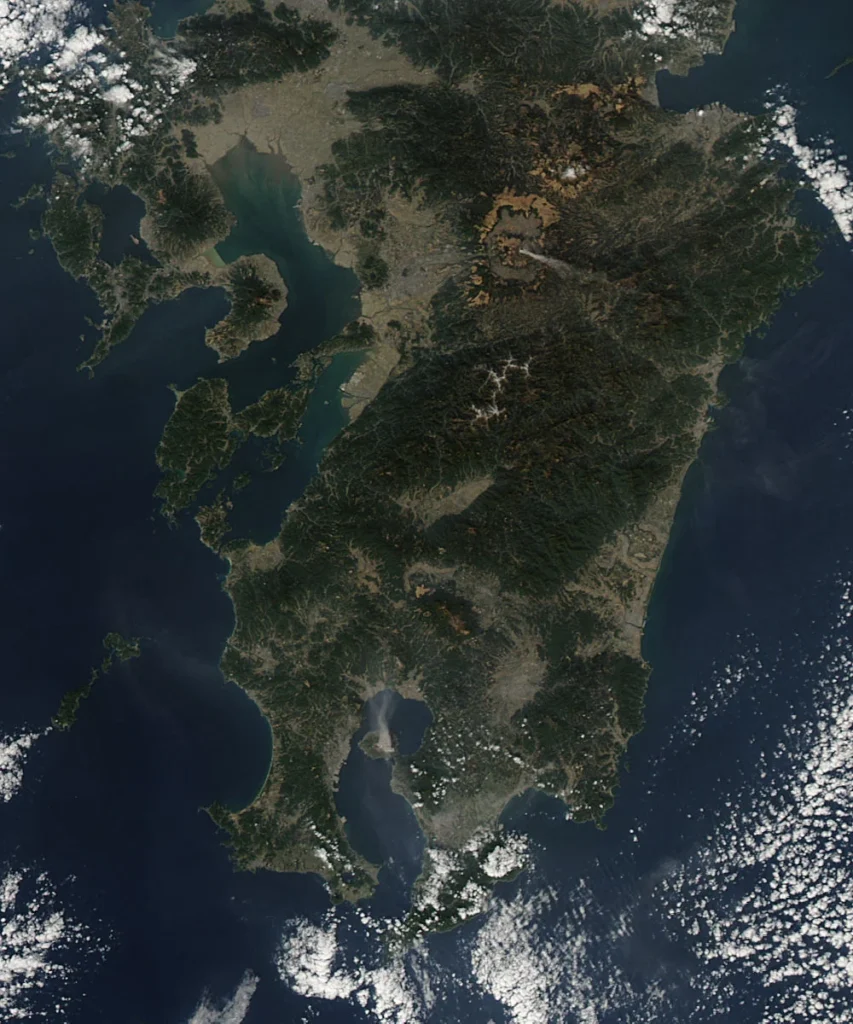
Asosan is a caldera volcano located in Japan, standing at an elevation of 1,592 meters within a subduction zone and continental crust tectonic setting. According to the Smithsonian Global Volcanism Program, the volcano has a recorded history comprising 172 confirmed eruptions. This activity spans a vast timeline from its earliest recorded eruption in 8050 BCE up to its latest recorded eruption period concluding in October 2021 CE.
Overview of Eruption History
The formal record for Asosan contains 172 confirmed eruptions. Of these events, 166 include observations or estimates regarding the Volcanic Explosivity Index (VEI). The largest recorded VEI for the volcano is 3.0. Individual eruptive episodes have occurred across various active areas within the volcanic complex, such as the Jigoku explosion crater, Naka-dake, and the Nakadake Crater.
Historical documentation of Asosan's activity combines modern scientific dating methods—such as Argon-Argon (Ar/Ar) isotopic dating for ancient events—with centuries of reported human observations. For instance, an early prehistoric eruption at the Jigoku explosion crater is dated to 8050 BCE with an uncertain year modifier, carrying a VEI of 1.0. Later historical accounts capture frequent activity, such as a VEI 2.0 eruption at Naka-dake starting on February 15, 1522 CE, and another VEI 2.0 eruption at Naka-dake on May 1, 1835 CE.
Recent Activity and Chronology
In the modern era, Asosan has continued to display measurable eruptive behavior. A notable eruption occurred at the Nakadake Crater from October 7, 2016 CE, to November 12, 2016 CE, reaching a VEI of 3.0. A subsequent confirmed eruption began on October 14, 2021 CE, and ended on October 20, 2021 CE, with a VEI of 2.0. The volcano's profile lists 2021 as its last known eruption year, matching the conclusion of this October 2021 activity.
Century-by-Century Eruption Distribution
The frequency of recorded eruptions varies significantly across centuries, reflecting both the natural behavior of the volcano and the varying detail of historical record-keeping over millennia. The 172 confirmed eruptions are distributed across time as follows:
- 81st century BCE: 1 eruption
- 37th century BCE: 1 eruption
- 29th century BCE: 1 eruption
- 26th century BCE: 1 eruption
- 24th century BCE: 1 eruption
- 22nd century BCE: 1 eruption
- 21st century BCE: 1 eruption
- 19th century BCE: 1 eruption
- 17th century BCE: 1 eruption
- 14th century BCE: 1 eruption
- 13th century BCE: 1 eruption
- 5th century CE: 1 eruption
- 9th century CE: 2 eruptions
- 15th century CE: 4 eruptions
- 18th century CE: 4 eruptions
- 21st century CE: 10 eruptions
- 13th century CE: 11 eruptions
- 14th century CE: 11 eruptions
- 17th century CE: 12 eruptions
- 16th century CE: 17 eruptions
- 19th century CE: 23 eruptions
- 20th century CE: 65 eruptions
Frequently asked questions
How many eruptions has Asosan had?
Asosan has 172 confirmed eruptions recorded in the official Smithsonian Global Volcanism Program database.
When was Asosan's earliest recorded eruption?
The earliest recorded eruption in Asosan's timeline dates back to 8050 BCE at the Jigoku explosion crater.
When was Asosan's latest recorded eruption?
The latest recorded eruption took place from October 14 to October 20, 2021 CE.
What is the largest recorded VEI for Asosan?
The largest recorded Volcanic Explosivity Index (VEI) for Asosan is 3.0.
Image credits
- Jeff Schmaltz, MODIS Land Rapid Response Team, NASA GSFC — Wikimedia Commons source — Public domain
Sources and further context
Official datasets support the event-specific facts.