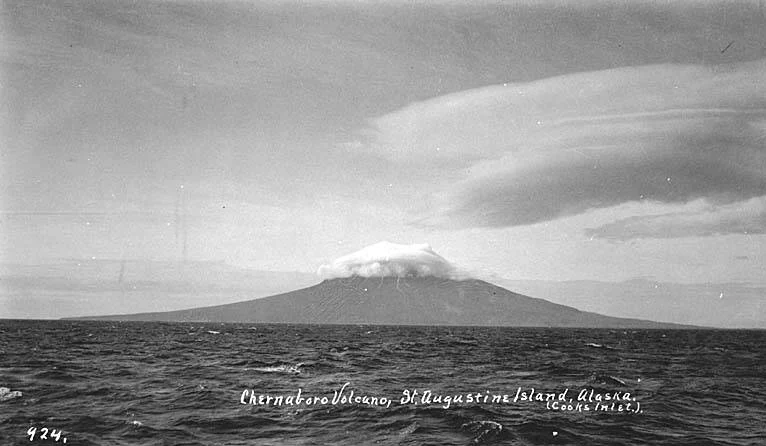
Augustine is a lava dome volcano located in the United States at 59.3626° N, -153.435° W, with an elevation of 1,218 meters. Situated in a subduction zone on continental crust exceeding 25 kilometers in thickness, the volcano has a recorded history of volcanic activity spanning multiple millennia.
According to the Smithsonian Global Volcanism Program, Augustine has a confirmed total of 22 eruptions. The earliest recorded eruption in this structured dataset dates back to 5420 BCE with a 50-year start-year uncertainty, determined via calibrated carbon-14 isotopic evidence. The most recent structured eruption entry in the official record began on December 9, 2005, and ended on April 27, 2006, reaching a Volcanic Explosivity Index (VEI) of 3.0 based on reported observations. The profile's overall last known eruption year is noted as 2006.
Historical Eruption Chronology and Evidence Methods
The historical record for Augustine is built upon a combination of calibrated isotopic dating for older prehistoric events and direct human reporting for modern episodes. Prehistoric eruptions are frequently dated using carbon-14 isotopic methods, which inherently carry temporal uncertainties—such as a 50-year uncertainty for the 5420 BCE event, a 100-year uncertainty for an eruption starting around 310 BCE, and a 50-year uncertainty for an event starting in 1230 CE.
In contrast, well-documented modern eruptions rely on direct scientific and reported observations. For example, an eruption that began on March 27, 2006, and concluded on August 31, 1986 (noted as eruption number 20262) reached a larger Volcanic Explosivity Index of 4.0. Out of the 22 total confirmed eruptions, 10 include recorded VEI classifications in the official dataset.
Distribution of Eruptions Over Time
Volcanic activity at Augustine has been distributed irregularly across centuries and millennia, appearing across various eras in the official record:
- 55th century BCE: 1 recorded eruption (starting around 5420 BCE)
- 42nd century BCE: 1 recorded eruption
- 21st century BCE: 1 recorded eruption
- 19th century BCE: 1 recorded eruption
- 4th century BCE: 2 recorded eruptions
- 2nd century BCE: 1 recorded eruption
- 6th century CE: 1 recorded eruption
- 10th century CE: 1 recorded eruption
- 13th century CE: 1 recorded eruption (starting around 1230 CE)
- 16th century CE: 1 recorded eruption
- 17th century CE: 1 recorded eruption
- 19th century CE: 2 recorded eruptions
- 20th century CE: 6 recorded eruptions
- 4th century CE / 21st century CE: Additional single-century entries as cataloged in the global record.
Frequently asked questions
Where is Augustine volcano located?
Augustine is located in the United States, positioned at latitude 59.3626 and longitude -153.435.
How many eruptions has Augustine had?
The Smithsonian Global Volcanism Program records a total of 22 confirmed eruptions for Augustine.
What is the largest recorded VEI for Augustine?
The largest recorded Volcanic Explosivity Index (VEI) for Augustine is 4.0.
When did Augustine most recently erupt?
The earliest recorded eruption in the structured dataset dates to 5420 BCE, and the latest structured eruption began on December 9, 2005, with the volcano's profile noting 2006 as its last known eruption year.
Image credits
- John E. Thwaites — Wikimedia Commons source — Public domain
Sources and further context
Official datasets support the event-specific facts.