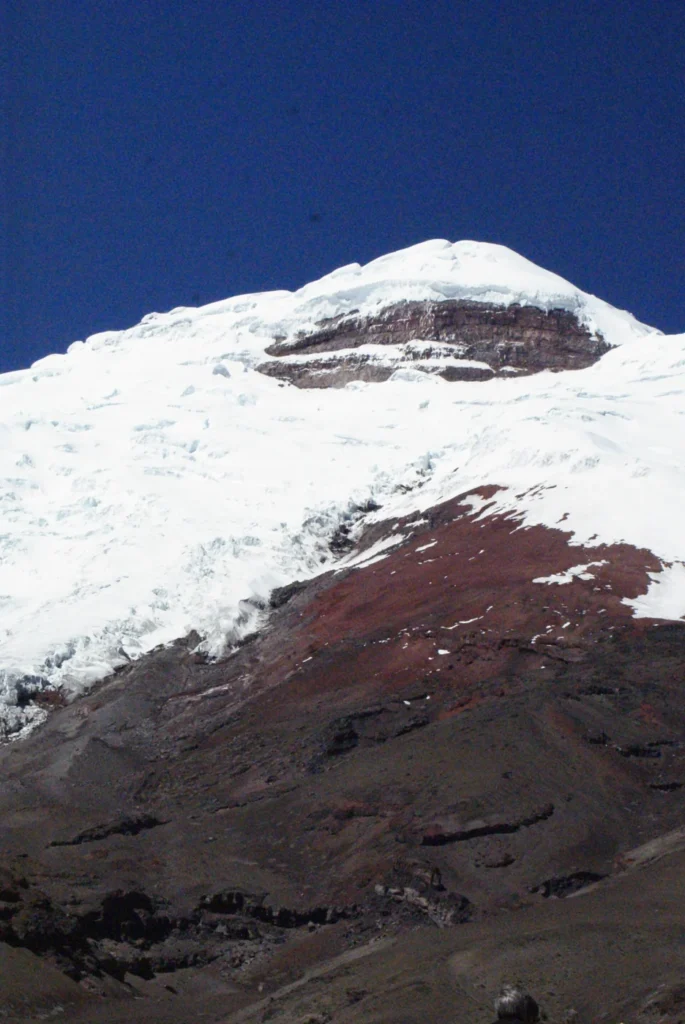
Cotopaxi is a stratovolcano located in Ecuador at an elevation of 5,911 meters within a subduction zone and continental crust setting (greater than 25 km). Maintained by the Smithsonian Global Volcanism Program's official record, the volcano features 85 confirmed eruptions spanning a timeline from early isotopic evidence in 7690 BCE through a summit crater activity period ending on July 6, 2023.
The historical and prehistoric record incorporates diverse evidence methods, ranging from uncalibrated radiocarbon dating and tephrochronology to direct historical observations. The largest recorded eruption in the available data reached a Volcanic Explosivity Index (VEI) of 5.0, which occurred around 1130 CE with an uncalibrated radiocarbon uncertainty of 75 years.
Overview of Recorded Eruption Distribution
The 85 confirmed eruptions are distributed across multiple centuries, showing varying levels of documented activity over time. The earliest recorded event in the collection dates to 7690 BCE (with a 75-year uncertainty), while later centuries contain numerous documented episodes. The distribution of confirmed eruptions by century highlights how historical observation density and geological dating methods capture the volcano's long-term behavior:
- 77th century BCE: 1 eruption
- 59th century BCE: 1 eruption
- 44th century BCE: 1 eruption
- 39th century BCE: 1 eruption
- 33rd century BCE: 1 eruption
- 27th century BCE: 1 eruption
- 23rd century BCE: 2 eruptions
- 21st century BCE: 1 eruption
- 16th century BCE: 1 eruption
- 11th century BCE: 1 eruption
- 8th century BCE: 1 eruption
- 4th century BCE: 1 eruption
- 3rd century BCE: 1 eruption
- 1st century BCE: 1 eruption
- 1st century CE: 1 eruption
- 2nd century CE: 2 eruptions
- 4th century CE: 1 eruption
- 6th century CE: 1 eruption
- 8th century CE: 2 eruptions
- 10th century CE: 1 eruption
- 12th century CE: 1 eruption
- 13th century CE: 1 eruption
- 14th century CE: 1 eruption
- 16th century CE: 3 eruptions
- 17th century CE: 1 eruption
- 18th century CE: 12 eruptions
- 19th century CE: 32 eruptions
- 20th century CE: 10 eruptions
- 21st century CE: 2 eruptions
Selected Historical and Prehistoric Eruptions
To illustrate the variety of documentation methods and scales associated with Cotopaxi, representative records from the Smithsonian Global Volcanism Program database detail specific events across its timeline:
- 7690 BCE: A confirmed eruption (eruption number 11510) evaluated via uncalibrated 14C isotopic evidence, assigned a VEI of 2.0 with a start year uncertainty of 75 years.
- 0950 CE: An eruption identified through tephrochronology correlation, noted with a questionable start year modifier and a VEI of 3.0.
- 1130 CE: The largest recorded event in the collection (eruption number 11534), carrying a VEI of 5.0 and determined via uncalibrated 14C isotopic evidence with a 75-year uncertainty.
- 1844 CE: A directly observed and reported eruption beginning on July 2, 1844 (eruption number 11555), with a VEI of 2.0.
- 2022–2023 CE: An activity period originating at the summit crater that began on October 21, 2022, and concluded on July 6, 2023 (eruption number 22486), recorded through reported observations with a VEI of 2.0.
Frequently asked questions
How many eruptions has Cotopaxi had?
Cotopaxi has 85 confirmed eruptions listed in the official Smithsonian Global Volcanism Program record.
When was Cotopaxi's earliest recorded eruption?
The earliest recorded eruption in the dataset dates back to 7690 BCE, with a 75-year uncertainty.
What is the largest recorded VEI for Cotopaxi?
The largest recorded eruptions at Cotopaxi reached a Volcanic Explosivity Index (VEI) of 5.0.
When was Cotopaxi's latest recorded eruption?
The latest recorded eruption period began on October 21, 2022, and ended on July 6, 2023.
Sources and further context
Official datasets support the event-specific facts.