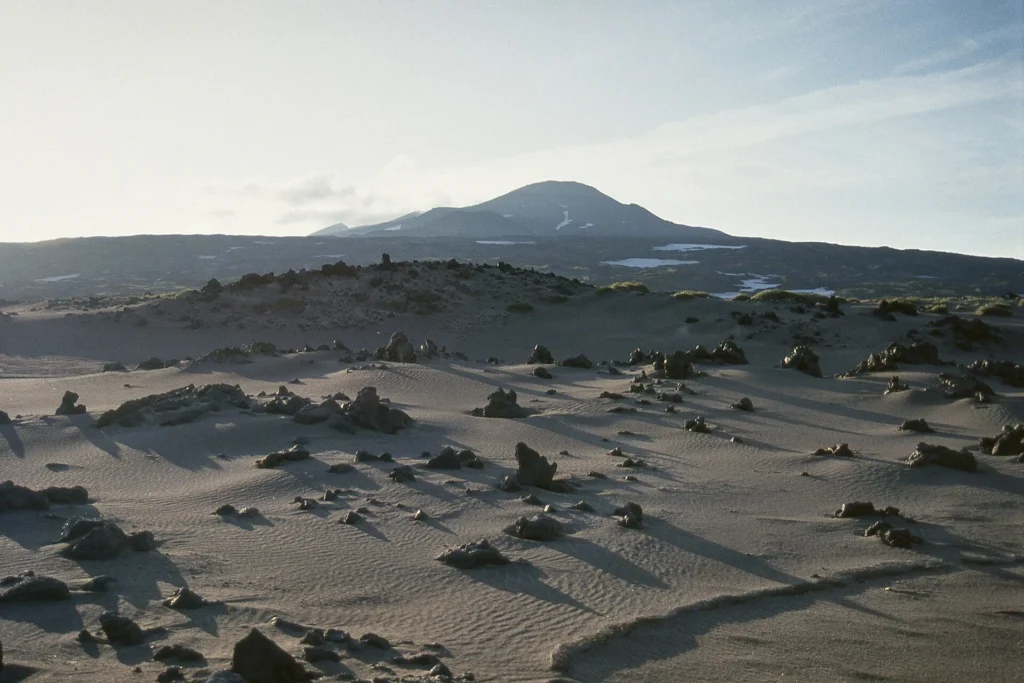
Gorely is a caldera volcano located in Russia, positioned within a subduction zone on continental crust over 25 kilometers thick. Standing at an elevation of 1,799 meters, the volcano has a documented history of volcanic activity spanning thousands of years, with records derived from both historical observations and scientific methods such as tephrochronology—the study of tephra layers left by past eruptions.
Overview of Recorded Activity
According to official records from the Smithsonian Global Volcanism Program, Gorely has a confirmed total of 50 eruptions. The earliest recorded eruption in the collection dates back to 7400 BCE, carrying an estimated start year uncertainty of 150 years. Eruption activity is measured using the Volcanic Explosivity Index (VEI), a relative scale that describes the size and magnitude of explosive volcanic events. Across Gorely's recorded history, the largest confirmed VEI value reaches 3.0.
The volcano's activity spans numerous centuries, ranging from prehistoric Holocene events to modern historical observations. For example, a confirmed eruption occurred with a start date of June 15, 1980, and ended on July 3, 1981, registering a VEI of 3.0 based on reported observations. More recently, activity at the summit crater produced a confirmed eruption starting on June 6, 2010, and ending on June 22, 2010, with a VEI of 1.0.
Frequently asked questions
Where is Gorely located?
Gorely is located in Russia in a subduction zone setting on continental crust.
How many confirmed eruptions does Gorely have?
The official record lists 50 confirmed eruptions for Gorely, with the earliest dating back to 7400 BCE and the latest concluding in 2010.
What is the highest Volcanic Explosivity Index (VEI) recorded for Gorely?
The largest recorded VEI for Gorely is 3.0.
Sources and further context
Official datasets support the event-specific facts.