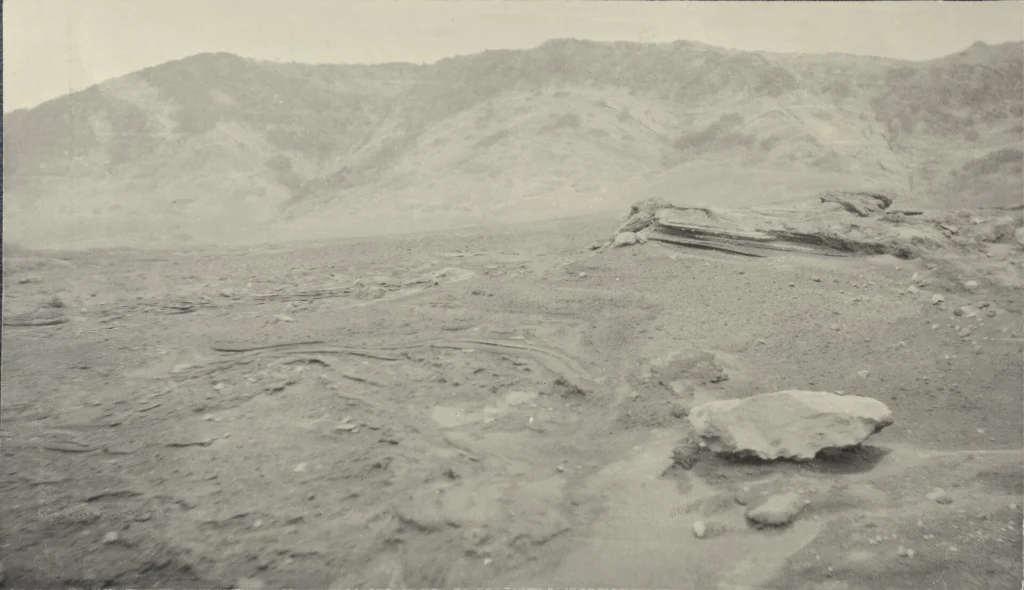
Izu-Oshima is a stratovolcano located in Japan with an elevation of 758 meters, positioned within a subduction zone on oceanic crust less than 15 kilometers thick. According to the Smithsonian Global Volcanism Program, the volcano has a recorded history comprising 99 confirmed eruptions. The earliest recorded eruption in the dataset dates back to 8450 BCE, while the latest confirmed eruption concluded on October 4, 1990.
Geographic and Tectonic Setting
The volcano is situated at coordinates 34.724°N and 139.394°E. Its tectonic setting is characterized by subduction zone activity along oceanic crust. Activity across its history has involved various areas of the volcanic structure, including the summit, flanks, and specific craters such as Mihara-yama, which was noted during the 1987 summit crater activity leading up to the 1990 eruption.
Eruption History and Chronology
The 99 confirmed eruptions span multiple millennia, utilizing various evidence methods ranging from early tephrochronology and calibrated carbon-14 isotopes to historical observations. The largest recorded Volcanic Explosivity Index (VEI) for Izu-Oshima is 4.0. Out of the 99 confirmed eruptions, 71 have associated VEI observations.
Historical eruptions are distributed across numerous centuries, with higher concentrations appearing in more recent centuries within the historical and modern observational records—such as 35 confirmed eruptions in the 20th century CE—compared to earlier millennia where events are identified through geological dating methods like tephrochronology and isotopic analysis.
Notable Historical Events
Selected representative records from the Smithsonian Global Volcanism Program illustrate the chronological range of Izu-Oshima's activity:
- 8450 BCE: The earliest recorded eruption in the dataset, identified via tephrochronology correlation with an uncertain start year modifier.
- 0340 CE (approximate): A VEI 4.0 eruption located at the summit and east flank, determined via calibrated carbon-14 isotopic analysis with a 200-year uncertainty window.
- May 14, 1421: A VEI 4.0 eruption at the summit and southern flank, documented through reported observations.
- 1623 CE: An eruption documented via reported observations without an assigned VEI.
- October 4, 1990: A VEI 2.0 eruption at the Mihara-yama 1987 summit crater, representing the latest confirmed eruption date in the official record.
Frequently asked questions
How many eruptions has Izu-Oshima had?
Izu-Oshima has 99 confirmed eruptions recorded in the Smithsonian Global Volcanism Program database.
When was Izu-Oshima's earliest recorded eruption?
The earliest recorded eruption in the dataset dates back to 8450 BCE.
When was Izu-Oshima's last confirmed eruption?
The latest confirmed eruption concluded on October 4, 1990.
What is the largest recorded VEI for Izu-Oshima?
The largest recorded Volcanic Explosivity Index (VEI) for Izu-Oshima is 4.0.
Image credits
- Immanuel Friedlaender — Wikimedia Commons source — Public domain
Sources and further context
Official datasets support the event-specific facts.