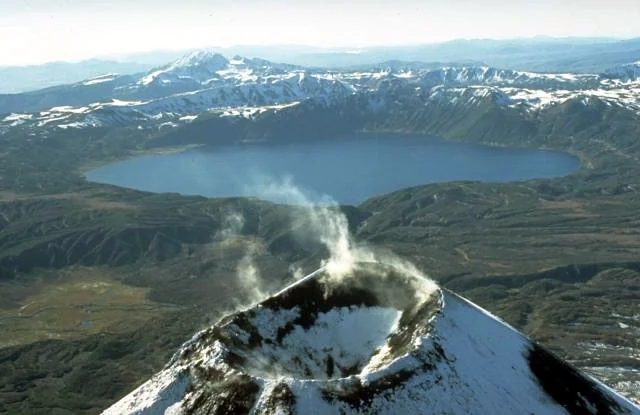
Karymsky is an active stratovolcano located in Russia at geographic coordinates 54.049° N, 159.443° E, with a peak elevation of 1,513 meters above sea level. According to data maintained by the Smithsonian Global Volcanism Program (volcano number 300130), the volcano sits within a subduction zone setting situated on continental crust thicker than 25 kilometers. Across its documented geological and modern history, Karymsky has 53 confirmed eruptions spanning from 6600 BCE to 2025 CE.
Tectonic Context and Volcanic Classification
As a stratovolcano, Karymsky is constructed from alternating layers of volcanic material produced during successive explosive and effusive eruptive episodes. Its regional tectonic environment is characterized by subduction zone dynamics, where oceanic crust descends beneath the continental crust of Eastern Russia. The underlying crust at Karymsky exceeds 25 kilometers in thickness, influencing the magmatic processes that feed the volcano's eruptive centers.
Geological Eruption Record and Maximum Explosivity
The catalog of Karymsky's activity includes 53 confirmed eruptive periods. The earliest documented event in the geological record occurred around 6600 BCE (66th century BCE) within the Karymsky caldera area. This event was identified and dated using calibrated radiocarbon (14C) isotopic analysis.
The 6600 BCE eruption represents the largest known explosive event in Karymsky's catalog, attaining a Volcanic Explosivity Index (VEI) rating of 6.0. The VEI scale measures explosive magnitude based on erupted volume and eruption column height. Out of the 53 confirmed eruptions recorded for Karymsky, 44 have assigned VEI ratings in official database records.
Chronological Distribution of Activity
The long-term eruption catalog transitions from prehistoric radiocarbon-dated events to direct observational reports in modern history. A total of 10 prehistoric eruptions spanning from the 66th century BCE to the 9th century BCE have been identified using isotopic dating methods. Following occasional documented activity through the medieval period and early modern centuries, reporting frequency increased substantially in the 20th and 21st centuries CE.
During the 20th century CE alone, 27 distinct confirmed eruptions were recorded. In the 21st century CE, 6 confirmed eruptive periods have been cataloged up to 2025.
| Time Period | Confirmed Eruptions |
|---|---|
| 66th century BCE | 1 |
| 42nd century BCE | 1 |
| 35th century BCE | 1 |
| 32nd century BCE | 1 |
| 24th century BCE | 1 |
| 23rd century BCE | 1 |
| 21st century BCE | 1 |
| 14th century BCE | 1 |
| 11th century BCE | 1 |
| 9th century BCE | 1 |
| 10th century CE | 1 |
| 11th century CE | 1 |
| 12th century CE | 1 |
| 15th century CE | 1 |
| 16th century CE | 1 |
| 18th century CE | 2 |
| 19th century CE | 3 |
| 20th century CE | 27 |
| 21st century CE | 6 |
Modern Eruption Observations
In the modern period, recorded observations replace isotopic dating as the primary evidence method. Representative documented eruptions from the mid-20th century CE include an eruption starting July 16, 1925, and another beginning July 2, 1953, both rated at VEI 2.0 based on reported observational data.
The most recent confirmed eruption cataloged for Karymsky began on April 29, 2025, and concluded on August 27, 2025. This event was confirmed through reported observations and was assigned a VEI rating of 2.0.
Frequently asked questions
How many confirmed eruptions are recorded for Karymsky?
According to the Smithsonian Global Volcanism Program, Karymsky has 53 confirmed eruptions in its historical and geological catalog, spanning from 6600 BCE to 2025 CE.
What is the largest recorded explosive eruption at Karymsky?
The largest recorded event at Karymsky is a Volcanic Explosivity Index (VEI) 6.0 eruption dated to approximately 6600 BCE in the Karymsky caldera area, established using calibrated radiocarbon dating.
When did the most recent recorded eruption of Karymsky occur?
Karymsky's most recent confirmed eruption began on April 29, 2025, and ended on August 27, 2025. It reached a Volcanic Explosivity Index (VEI) of 2.0.
Image credits
- Contributor — Wikimedia Commons source — Public domain
Sources and further context
Official datasets support the event-specific facts.