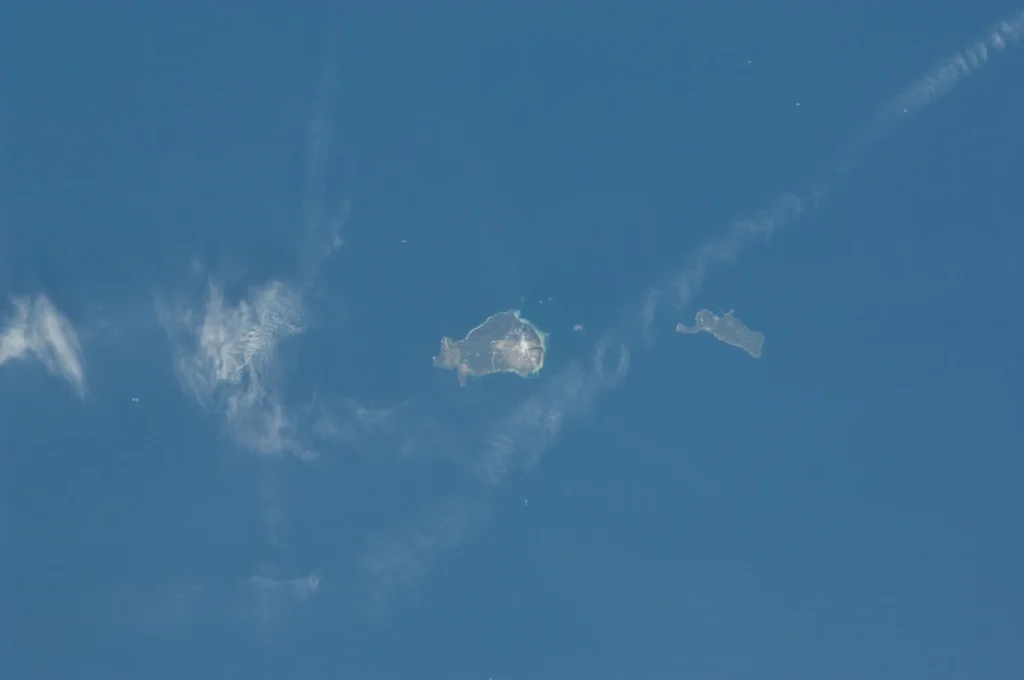
Kikai is a caldera volcano located in Japan at a subduction zone on oceanic crust less than 15 kilometers deep, reaching an elevation of 704 meters. According to the Smithsonian Global Volcanism Program, the volcano has a recorded history comprising 28 confirmed eruptions. These events span from the earliest recorded eruption in 4350 BCE up to activity recorded in 2025 CE.
Overview of Recorded Eruptions
The historical record for Kikai includes a range of eruption scales and observation methods. Out of the 28 confirmed eruptions in the official record, 19 have assigned Volcanic Explosivity Index (VEI) values, reaching a largest recorded VEI of 7.0. The activity has occurred across different locations within the volcanic complex, including the Kikai caldera and the Iwo-dake / Iodake Crater areas. Evidence for these eruptions is derived from a variety of methods, ranging from uncalibrated radiocarbon dating and tephrochronology for ancient events to direct reported observations for modern activity.
Chronological Distribution of Activity
Recorded eruptions at Kikai are distributed across multiple centuries, starting with prehistoric events and extending into the 21st century CE. The confirmed eruptions are grouped across centuries as follows:
- 44th century BCE: 1 eruption (starting in 4350 BCE with a VEI of 7.0)
- 33rd century BCE: 1 eruption
- 25th century BCE: 1 eruption
- 19th century BCE: 1 eruption
- 11th century BCE: 1 eruption
- 3rd century BCE: 1 eruption
- 4th century CE: 1 eruption
- 8th century CE: 1 eruption (starting around 0750 CE with a VEI of 3.0)
- 9th century CE: 1 eruption
- 11th century CE: 2 eruptions
- 14th century CE: 1 eruption
- 15th century CE: 1 eruption
- 20th century CE: 6 eruptions (including an event ending on January 18, 1988, with a VEI of 1.0)
- 21st century CE: 9 eruptions (including an event from February 16, 2003, to October 16, 2003, with a VEI of 2.0, and an eruption on December 29, 2025, with a VEI of 1.0)
Representative Eruptions
To illustrate the variety of documentation in the official record, selected representative eruptions include:
- 4350 BCE: A large-scale event at the Kikai caldera with a VEI of 7.0, documented via uncalibrated radiocarbon isotopic evidence.
- 0750 CE: An eruption at Iwo-dake with a VEI of 3.0, identified through tephrochronology correlation.
- 1988 (January 18): A minor eruption at Iwo-dake with a VEI of 1.0, recorded through direct observations.
- 2003 (February 16 – October 16): An eruptive period at Iwo-dake with a VEI of 2.0, documented by reported observations.
- 2025 (December 29): An eruption at Iodake Crater with a VEI of 1.0, noted from reported observations.
Frequently asked questions
How many eruptions has Kikai had?
Kikai has 28 confirmed eruptions recorded in the official Smithsonian Global Volcanism Program database.
When did Kikai's earliest recorded eruption take place?
The earliest recorded eruption in the official record for Kikai occurred in 4350 BCE.
What is the largest recorded VEI for Kikai?
The largest recorded eruptions at Kikai reached a Volcanic Explosivity Index (VEI) of 7.0.
Where is Kikai volcano located?
Kikai is located in Japan at a latitude of 30.793 and longitude of 130.305, standing at an elevation of 704 meters.
Image credits
- Earth Science and Remote Sensing Unit , Lyndon B. Johnson Space Center — Wikimedia Commons source — Public domain
Sources and further context
Official datasets support the event-specific facts.