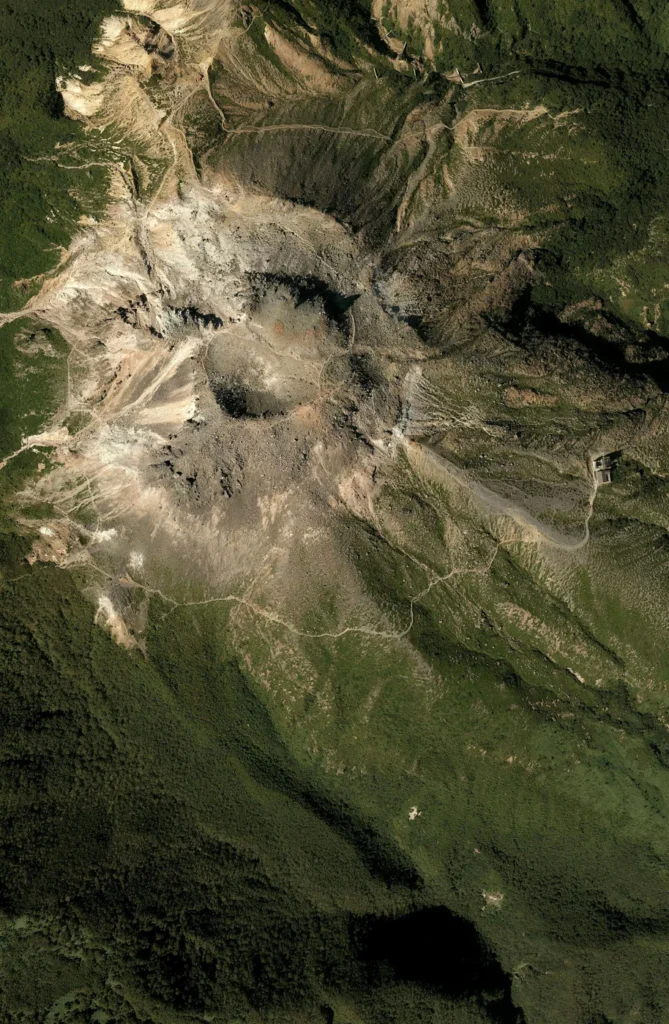
Nasudake is a stratovolcano situated in Japan at a tectonic subduction zone within continental crust exceeding 25 km in thickness. Standing at an elevation of 1,915 meters, the volcano has a recorded history of 20 confirmed eruptions. According to the Smithsonian Global Volcanism Program's official records, these events span a broad timeline from prehistoric tephrochronology matches around 8550 BCE up to historical human observations in the 20th century CE.
The volcano's documented activity level encompasses a range of evidence methods, including calibrated radiocarbon dating, tephrochronology correlations, and direct human observations. Across the 20 confirmed events, the largest recorded Volcanic Explosivity Index (VEI) reaches 3.0.
Overview of Recorded Eruptions
The official record for Nasudake documents 20 confirmed eruptions distributed across multiple centuries and millennia. The earliest recorded event dates back to approximately 8550 BCE, carrying a start-year uncertainty of 1,500 years and assessed with a VEI of 2.0 based on tephrochronology correlation. Subsequent prehistoric and historical activity occurred at intervals, identified through varying scientific techniques.
Representative milestones within the eruption history include:
- 8550 BCE (approximate): An early confirmed eruption at the Chausu-dake activity area with a VEI of 2.0, derived via tephrochronology correlation and subject to a 1,500-year uncertainty window.
- 2000 BCE (approximate): A Chausu-dake activity area eruption with a VEI of 2.0 and a 1,450-year uncertainty range.
- 0330 CE (approximate): Activity at Chausu-dake logged with a VEI of 2.0, determined using calibrated isotopic 14C methods with a 200-year uncertainty.
- March 5, 1410 CE: A reported observational eruption at Chausu-dake reaching the highest recorded VEI for the volcano at 3.0.
- November 20–21, 1963 CE: The latest recorded eruption in the official dataset, located on the west side of Chausu-dake, observed directly with a VEI of 1.0.
Eruption Chronology and Methods
The methods used to document Nasudake's eruptions transition over time from geological and isotopic proxies to direct historical chronicles. Older events—such as those in the 86th, 79th, 61st, 56th, 44th, and 15th centuries BCE, as well as the 3rd century BCE—rely heavily on tephrochronology and isotopic dating, which inherently carry year uncertainties ranging from decades to millennia. Conversely, more recent events, such as the 1410 CE and 1963 CE occurrences, are grounded in direct historical reports and human observations.
The Volcanic Explosivity Index (VEI) values assigned to these 20 confirmed events scale the relative size of the eruptions, with the maximum recorded magnitude standing at VEI 3.0. The most recent activity concluded on November 21, 1963.
Frequently asked questions
Where is Nasudake located and what type of volcano is it?
Nasudake is a stratovolcano located in Japan, standing at an elevation of 1,915 meters.
How many eruptions have been recorded at Nasudake?
The official Smithsonian Global Volcanism Program record documents 20 confirmed eruptions for Nasudake.
When did the earliest and latest recorded eruptions take place?
The earliest recorded eruption in the dataset occurred around 8550 BCE, and the latest recorded eruption took place on November 20–21, 1963.
What is the largest recorded VEI for Nasudake?
The largest recorded Volcanic Explosivity Index (VEI) for Nasudake is 3.0.
Image credits
- ContributorQ — Wikimedia Commons source — CC BY 4.0
Sources and further context
Official datasets support the event-specific facts.