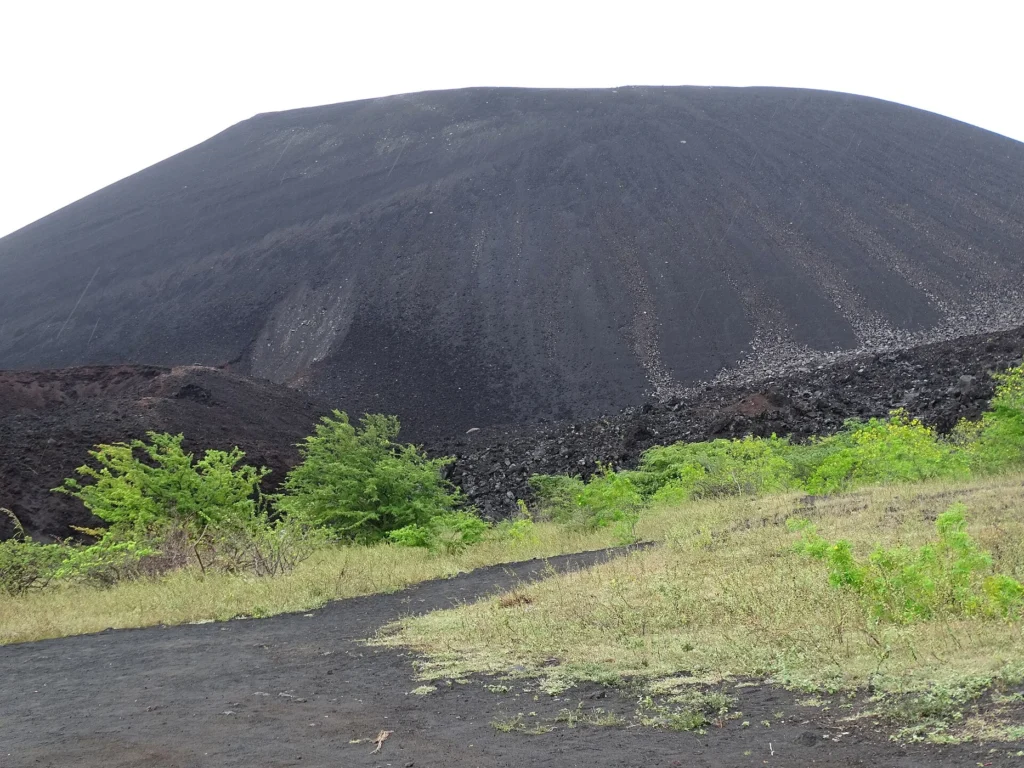
Cerro Negro is a pyroclastic cone volcano located in Nicaragua, standing at an elevation of 728 meters within a subduction zone and continental crust tectonic setting. According to official records from the Smithsonian Global Volcanism Program, the volcano has a confirmed history of 23 eruptions spanning from the 19th century CE through the 20th century CE.
Recorded Eruption Timeline and Century Distribution
The historical record for Cerro Negro spans across two centuries, with documented activity beginning in the 19th century CE and continuing through the 20th century CE. The Global Volcanism Program records 3 eruptions during the 19th century CE and 20 instances of activity during the 20th century CE. All recorded eruptions carry observation-based evidence methods indicating they were reported.
The earliest recorded eruption in the available dataset began on April 13, 1850 CE, and concluded on May 27, 1850 CE, with a Volcanic Explosivity Index (VEI) of 2.0. Subsequent historical activity includes events such as the eruption spanning from February 10, 1929 CE, to March 16, 1929 CE (VEI 2.0), and a shorter event on February 16, 1954 CE (VEI 2.0).
Larger Recorded Activity and Latest Eruptions
Throughout its recorded history, Cerro Negro's largest recorded Volcanic Explosivity Index (VEI) reached 3.0. An example of this magnitude occurred during an eruption from April 9, 1992 CE, to April 14, 1992 CE (VEI 3.0).
The profile's latest recorded eruption started on August 5, 1999 CE, and ended on August 7, 1999 CE, with a VEI of 2.0. This particular activity occurred on the south flank near the Cristo Rey crater. Across all 23 recorded eruptions, VEI observations are fully documented, and all listed historical events are marked as non-continuing.
Sources and further context
Official datasets support the event-specific facts.