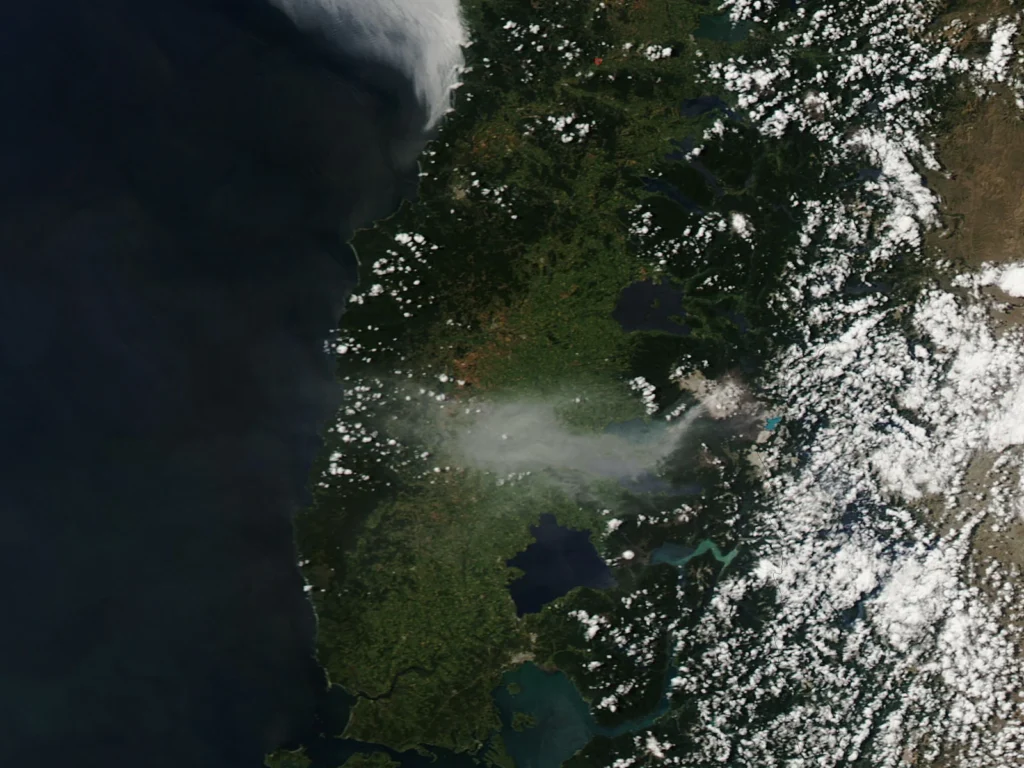
Puyehue-Cordón Caulle is a stratovolcano located in Chile at a latitude of -40.59 and a longitude of -72.117, standing at an elevation of 2,236 meters. Situated in a subduction zone and continental crust tectonic setting (greater than 25 km), the volcano has a documented history featuring 26 confirmed eruptions managed within the Smithsonian Global Volcanism Program records.
Overview of Eruption History
The official record for Puyehue-Cordón Caulle includes 26 confirmed eruptions spanning from its earliest recorded year of 5080 BCE through 2011. Across this timeline, activity has been distributed across multiple centuries, utilizing varying evidence methods ranging from calibrated radiocarbon dating for ancient events to direct historical observations for modern activity. The largest recorded Volcanic Explosivity Index (VEI) in the official record is 5.0.
Selected Historical Eruptions
The confirmed eruption collection details various events across different activity areas:
- 5080 BCE (± 150 years): An early confirmed eruption occurred in the Puyehue activity area with a Volcanic Explosivity Index of 5.0, determined via calibrated 14C isotopic evidence.
- 1490 BCE (± 150 years): A confirmed eruption took place in the Puyehue-Cordón Caulle system, supported by calibrated 14C isotopic evidence.
- 860 CE (± 75 years): A VEI 5.0 eruption occurred in the Puyehue activity area, identified through calibrated isotopic evidence.
- 1919–1920: A confirmed eruption took place in the Cordón Caulle activity area, starting on July 2, 1919, and ending on July 2, 1920, with a VEI of 2.0, documented through reported observations.
- 2011–2012: A major eruption began on June 4, 2011, north of the 1960 eruption fissure in the Cordón Caulle activity area, reaching a VEI of 5.0 and concluding on April 21, 2012, based on reported observations.
Temporal Distribution of Activity
Confirmed eruptions at Puyehue-Cordón Caulle are distributed across various centuries and millennia in the official record:
- 47th to 33rd centuries BCE: Includes activity in the 51st, 47th, 45th, 43rd, and 33rd centuries BCE.
- 5th century BCE to 2nd century CE: Includes records in the 5th and 10th centuries BCE, as well as the 2nd and 5th centuries CE.
- Medieval and Early Modern periods: Records note activity in the 9th, 12th, 13th, 15th, 18th, and 19th centuries CE.
- Modern period: The 20th century CE contains 8 confirmed eruptions, and the 21st century CE includes activity starting in 2011.
Frequently asked questions
Where is Puyehue-Cordón Caulle located?
Puyehue-Cordón Caulle is located in Chile, positioned at latitude -40.59 and longitude -72.117.
How many eruptions has Puyehue-Cordón Caulle had?
The official record documents 26 confirmed eruptions for the volcano.
What is the largest recorded VEI for Puyehue-Cordón Caulle?
The largest recorded Volcanic Explosivity Index (VEI) in the official record for this volcano is 5.0.
When was the earliest recorded eruption?
The earliest recorded eruption in the official dataset dates back to 5080 BCE, with a 150-year uncertainty margin.
Image credits
- NASA. Satellite: Aqua. — Wikimedia Commons source — Public domain
Sources and further context
Official datasets support the event-specific facts.