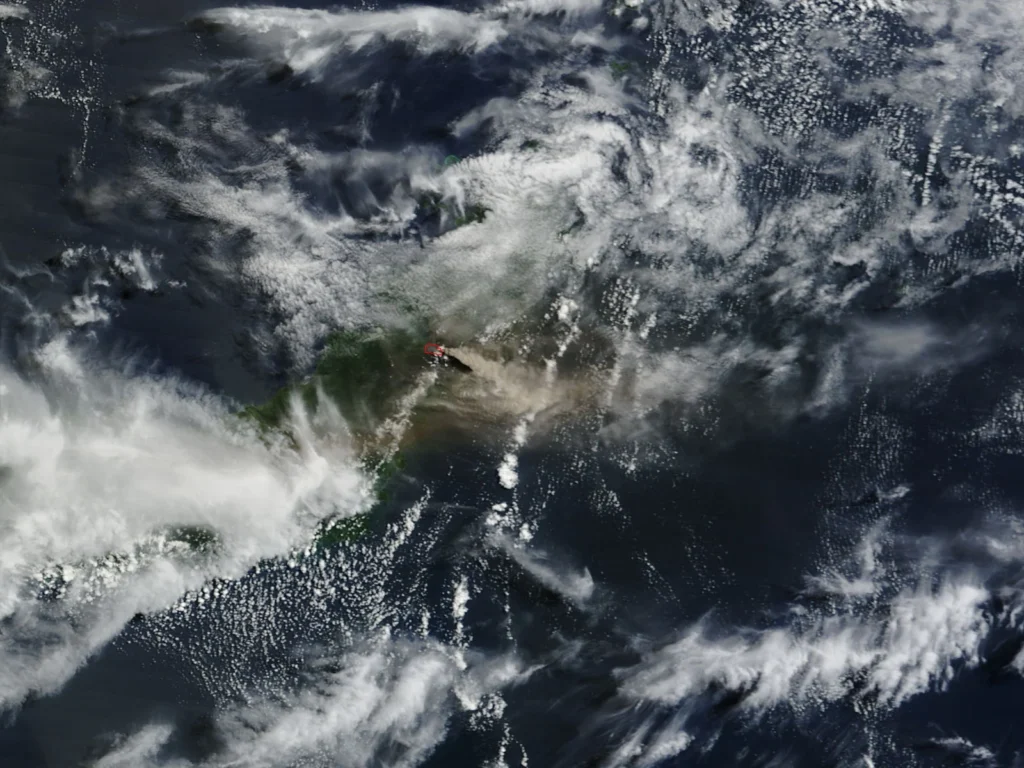
Soputan is a stratovolcano located in Indonesia at an elevation of 1,785 meters, situated within a subduction zone and continental crust setting exceeding 25 kilometers in thickness. According to the Smithsonian Global Volcanism Program, the volcano has a documented history of 41 confirmed eruptions spanning from the 15th century CE up to 2020.
Overview of Recorded Activity
The historical record for Soputan includes 41 confirmed eruptions evaluated across multiple centuries. Observations of these events rely primarily on reported accounts. The earliest recorded eruption in the official database occurred in 1450 CE, with a start year uncertainty of 10 years, and reached a Volcanic Explosivity Index (VEI) of 3.0. Across the entire recorded catalog, all 41 eruptions have associated VEI observations, with the largest recorded VEI reaching 3.0.
Century-by-Century Eruption Distribution
Eruptive activity at Soputan has been documented across five centuries, with the highest concentration of recorded events occurring during the 20th century CE. The distribution of confirmed eruptions by century is as follows:
- 15th century CE: 1 eruption
- 18th century CE: 1 eruption
- 19th century CE: 4 eruptions
- 20th century CE: 23 eruptions
- 21st century CE: 12 eruptions
Milestones in Historical Eruptions
Documented eruptions at Soputan exhibit various activity durations and vent locations across the edifice. For example, an eruption began on November 15, 1910, at the northeast flank (Aeseput) with a VEI of 2.0. Later events include a confirmed eruption sequence spanning from February 16, 1970, to May 26, 1970, also recorded at a VEI of 2.0. More recently, activity occurred at the summit crater, beginning on October 2, 2018, and ending on December 16, 2018, with a VEI of 3.0. The latest recorded eruption in the structured dataset began on March 23, 2020, and concluded on April 2, 2020, with a VEI of 2.0.
Image credits
- NASA Goddard MODIS Rapid Response Team — Wikimedia Commons source — Public domain
Sources and further context
Official datasets support the event-specific facts.