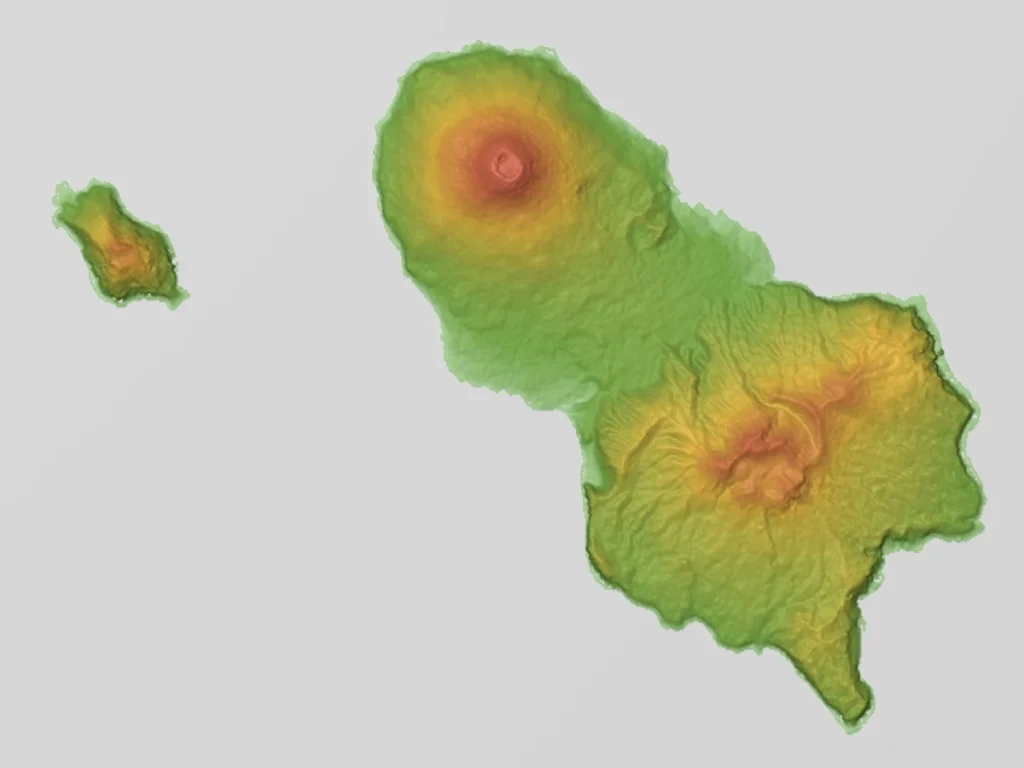
Geological Setting and Overview
Hachijojima is a stratovolcano located in Japan at latitude 33.137 and longitude 139.766. Situated in a subduction zone setting on thin oceanic crust less than 15 kilometers thick, the volcano reaches an elevation of 854.0 meters. Official data from the Smithsonian Global Volcanism Program documents a total of 18 confirmed eruptions throughout its geological history, spanning thousands of years from the prehistoric era into the early 17th century CE.
Eruptive Explosivity and Prehistoric Activity
The recorded volcanic explosivity at Hachijojima reaches a maximum Volcanic Explosivity Index (VEI) of 5.0. Of the 18 confirmed eruptions, 12 have assigned VEI ratings. Prehistoric activity has been reconstructed primarily using tephrochronological evidence.
The earliest documented eruption in the volcanic record occurred around 8020 BCE (with a start year uncertainty of 2,640 years) at Nishi-yama, producing a VEI 4.0 event. Additional prehistoric eruptions include an event centered at Nishi-yama around 3350 BCE (± 1,300 years). The largest known explosive event in the island's record took place around 2050 BCE in the area southeast of Nishi-yama and northeast of Higashi-yama, reaching a VEI of 5.0.
Historical Record and Latest Known Eruption
In later centuries, isotopic radiocarbon (14C) dating established an eruption around 850 CE (± 200 years) involving the summit and southeast flank of Nishi-yama. Historical eyewitness accounts documented the most recent confirmed activity: a submarine flank eruption that began on January 23, 1606 CE, producing a VEI 2.0 eruption.
Across the recorded timeline, confirmed eruptions are distributed sparsely through prehistoric millennia—including single recorded events in centuries such as the 81st, 77th, 51st, 47th, 34th, 27th, 26th, 25th, 21st, 13th, 12th, 4th, and 2nd centuries BCE. In the Common Era, recorded eruptions occurred in the 9th, 15th, and 16th centuries CE, with two recorded eruptions occurring in the 17th century CE.
Representative Confirmed Eruptions
The table below summarizes representative confirmed eruption events from the volcano's record, detailing activity locations, detection methods, and explosive scale where determined.
| Start Date | Activity Area | Evidence Method | VEI |
|---|---|---|---|
| 8020 BCE (± 2640 years) | Nishi-yama | Tephrochronology | 4.0 |
| 3350 BCE (± 1300 years) | Nishi-yama | Tephrochronology | Not reported |
| 2050 BCE (?) | SE of Nishi-yama, NE of Higashi-yama | Tephrochronology | 5.0 |
| 850 CE (± 200 years) | Nishi-yama summit and SE flank | Isotopic: 14C (calibrated) | Not reported |
| January 23, 1606 CE | Submarine flank | Observations: Reported | 2.0 |
Frequently asked questions
How many confirmed eruptions are recorded for Hachijojima?
The Smithsonian Global Volcanism Program records 18 confirmed eruptions for Hachijojima, ranging from 8020 BCE to 1606 CE.
When was the most recent confirmed eruption at Hachijojima?
The latest recorded eruption began on January 23, 1606 CE on a submarine flank, with a Volcanic Explosivity Index (VEI) of 2.0.
What was the largest known eruption in Hachijojima's history?
The largest recorded eruption reached a Volcanic Explosivity Index (VEI) of 5.0, dated to approximately 2050 BCE in the area southeast of Nishi-yama and northeast of Higashi-yama.
Image credits
- Batholith — Wikimedia Commons source — Public domain
Sources and further context
Official datasets support the event-specific facts.