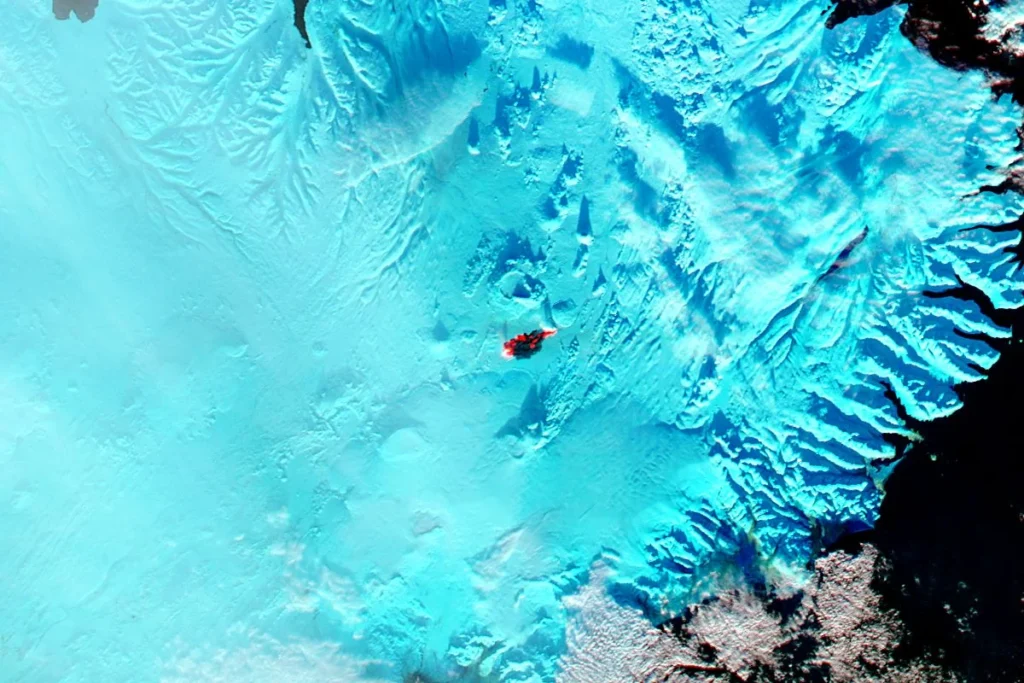
Bardarbunga is a stratovolcano located in Iceland, positioned within a rift zone on oceanic crust less than 15 kilometers thick. Standing at an elevation of 2,000 meters, the volcano carries a comprehensive Smithsonian Global Volcanism Program record comprising 44 confirmed eruptions. The timeline of recorded activity spans from early prehistoric tephrochronology matches dating back to 7100 BCE through to events in the 21st century CE.
Overview of Recorded Eruptions
According to the official volcano record, Bardarbunga has produced 44 confirmed eruptions. The earliest recorded activity in the data is placed at 7100 BCE, identified through tephrochronology correlation. Across the entire catalog, 21 eruptions include Volcanic Explosivity Index (VEI) values, reaching a largest recorded VEI of 6.0. The historical record includes diverse activity areas, ranging from regional fissure zones and tephra-producing events to vent openings situated dozens of kilometers away from the main edifice.
Historical Distribution of Activity
Confirmed eruptions at Bardarbunga are distributed unevenly across millennia and centuries. Prehistoric and early historical activity includes multiple records in the 71st, 67th, 50th, 48th, 46th, 44th, and 42nd centuries BCE, as well as the 12th century BCE. Common historical eras are also represented, with activity documented across the 9th, 10th, 11th, 12th, 13th, 14th, 15th, 17th, 18th, 19th, 20th, and 21st centuries CE. The 18th century CE accounts for the highest concentration of confirmed events in a single century within the dataset, recording 15 separate eruptions.
Notable Recorded Eruptions
Representative records from the Smithsonian Global Volcanism Program illustrate the range of activity types and documentation methods associated with Bardarbunga:
- 7100 BCE (?): An early confirmed eruption at the Trölladyngja (Bardarhalshraun) activity area, identified via tephrochronology correlation.
- 870 CE (?): An explosive event at Vatnaöldur assigned a VEI of 4.0, also correlated through tephrochronology.
- February 1477 CE: A large explosive eruption at the Veidivötn (Veidivatnahraun) area reaching the maximum recorded VEI of 6.0, documented via reported observations.
- 1729 CE: An eruption associated with uncertainty in the specific vent location (noted in the record as Volcano Uncertain: Dyngjuhals ?) with a VEI of 1.0.
- August 29, 2014 to February 27, 2015: A confirmed eruption originating from the Holuhraun vent located 45 kilometers northeast, recorded with a VEI of 0.0 based on reported observations.
The profile's last-known eruption year is listed as 2015, concluding with the Holuhraun vent activity that ended on February 27, 2015.
Frequently asked questions
How many eruptions has Bardarbunga recorded?
The Smithsonian Global Volcanism Program record confirms 44 eruptions for Bardarbunga.
When did Bardarbunga's earliest recorded eruption occur?
The earliest recorded eruption in the dataset dates back to 7100 BCE, determined through tephrochronology correlation.
What is the largest recorded VEI for Bardarbunga?
The largest recorded explosive magnitude for Bardarbunga is VEI 6.0, which occurred during the February 1477 eruption at Veidivötn.
When was Bardarbunga's most recent eruption?
The last-known eruption concluded on February 27, 2015, following activity that began on August 29, 2014, at the Holuhraun vent 45 km northeast.
Image credits
- NASA Goddard Space Flight Center from Greenbelt, MD, USA — Wikimedia Commons source — Public domain
Sources and further context
Official datasets support the event-specific facts.